

Over the  Christmas and New Year holidays, I re-watched the films of George Lucas’s Star Wars science fiction franchise. Although Star Wars is very well-known, it also has been almost 50 years since it first came out, so a quick synopsis is that it starts with a galaxy under the rule of a democratic but ineffectual government called the Galactic Republic. Internal strife and an outbreak of civil war lead to a politician, Palpatine, being able to seize absolute power and install himself as Galactic Emperor. The formation of the Galactic Empire inspires the rise of the Rebel Alliance. Over the decades, the franchise has produced nine films, which have a timeless quality, showing little awareness of current political and cultural trends but being archetypical enough that many of its themes can be applied to contemporary challenges.
The drivers of the story are individuals who are sensitive to a semi-sentient spiritual force (i.e., the Force). The concept of the Force is influenced by animism and eastern mysticism (George Lucas identifies as a “Buddhist Methodist”). The Force is variously described as being generated either mystically by all living things or by special cells in the body called midi-chlorians. Those born sensitive to the Force can sense the feelings (empathy) and thoughts (telepathy) of others as well as control matter through telekinesis. It seems also that mastery of the Force can be attained either through controlling one’s passions or embracing them fully. The latter leads to the “Dark Side of the Force.”
At the start of the franchise, this Force has become the focus of two diametrically opposed religious orders of light-saber wielding warrior monks. The Jedi seek to control their desires to focus their use of the Force toward duty and selfless service to others in order to bring peace and justice to the galaxy. The Sith, on the other hand, embrace the Dark Side of the Force and use it to accumulate power for themselves. Palpatine turns out to be a Sith who almost destroys the Jedi through the help of the Jedi-turned Sith Anakin Skywalker, who is renamed Darth Vader when he becomes a Sith. Darth Vader betrays the Jedi but at the end of Episode VI turns back to good and gives his life to save his Jedi son, Luke Skywalker, and defeat Emperor Palpatine. Vader could be seen as a sort of dark messiah who overcomes evil through self-sacrifice after turning good.
In re-watching the films, I was interested in the ways that both the Jedi and the Sith play a significant role in transforming the galactic civilization. The Jedi act as guardians of the Republic, safeguarding peace and justice. When the greedy Trade Federation attempts to invade the peaceful planet Naboo to exploit its natural resources in Episode I, the Jedi are called in to negotiate with the Trade Federation, though negotiations turn out to be short. When a league of separatists (instigated by the Sith) begins to threaten the Republic, the Jedi intervene at the First Battle of Geonosis in Episode II, albeit with the help of a clone army. It is also ultimately a Jedi who defeats Galactic Emperor Palpatine in Episode VI and restores peace and freedom to the galaxy.
The role of the Jedi is not limited to politics and society. It is also implied that they play a role in the accumulation of knowledge and the advancement of science. The Jedi Library on the urban planet Coruscant contains all knowledge known by the galactic civilization. In the Expanded Universe, which contains novels and games created by fans to expand on the canonical films, there are Jedi researchers who specialize in specific scientific fields, including archaeology, linguistics, geology, astronomy, and biology.
Other than the obvious role of the Sith in creating the Galactic Empire, it is also implied that the Sith actively encourage capitalistic exploitation and extractivism. In the recent Disney Star Wars spinoff shows such as Andor, Imperial officers talk of “profit.” A major plot element of Andor is the Galactic Empire inciting unrest on the planet Ghorman to create pretense for genocide so that the Empire can remove the current population and strip-mine the planet for a valuable mineral, kalkite.
Intriguingly, the Sith never appear to indulge in the luxuries that come from ruling an empire. Their lifestyle remains austere and monastic. In this way, they resemble Karl Marx’s description of early capitalists in volume I of Capital. The capitalists see themselves only as profit-making machines and shun indulging in the profits for the sake of luxury because that would make them less competitive. In this way, the Sith resemble the ideal capitalist. They have made exploitation and oppression for their own sake a calling as much as the Jedi have made peace and justice a calling.
The actions of the Jedi and the Sith are reflected in real-world religious orders. Because it is my background, I will focus on examples from the Christian tradition. One specific example is the Jesuits, who have a mixed history both in opposing and reinforcing imperialist oppression and exploitation at different times. An example of the latter is the role of the Jesuits in the Spanish conquest of Guam in the 17th and 18th centuries, where Jesuits acted as agents of Spanish colonialism, encouraging militarization, forced Catholicization, and replacement of the Indigenous culture with European culture. In contrast, the Jesuits have also been advocates and protectors of Indigenous people in Latin America, trying to shield them from the worst excesses of Spanish and Portuguese imperialism during reduccion (forced relocation).
More recently, Jesuits have worked to oppose European and U.S. imperialism in Latin America as shown by figures such as Ignacio Ellacuria in El Salvador and Ernesto Cardenal in Nicaragua. Jesuits have also distinguished themselves through their work as scientists, such as the planetary astronomer Guy Consolmagno and his work on meteorites, and activists for global peace, such as anti-Viet Nam war activists Daniel and Philip Berrigan (a Josephite).
It is less common for religious orders to make specific social causes their primary mission in the way that the Jedi, but there are modern examples, such as the multi-faith Order of the Sacred Earth which was founded specifically to advocate for protection of the environment and lacks connection to a specific religious tradition.
In this way, the order of the Sacred Earth draws on both science and faith to work toward justice and peace. Lutheran theologian Thomas Hoffman has proposed the concept of exomissiology, the investigation of possible dialogue with extraterrestrials about religion in a way that resists imperialism and colonialism, preserving cultural diversity and autonomy.
Today, most religious orders are in decline, but members of religious orders continue to inspire real social change. Historically, religious orders have been at the cutting edge of mysticism and spiritual development. Religious orders are likely to continue to have an influence on the direction of spirituality and religion even if they are no longer as influential as they were in the past.
Throughout history, religious orders have played both the role of the Jedi in being guardians of peace and justice and agents of social and scientific progress and of the Sith as agents of oppression and exploitation, shaping the course of their respective religions. Modern religions must decide whether they will choose the path of the Jedi or the Sith. Our future may depend on it.
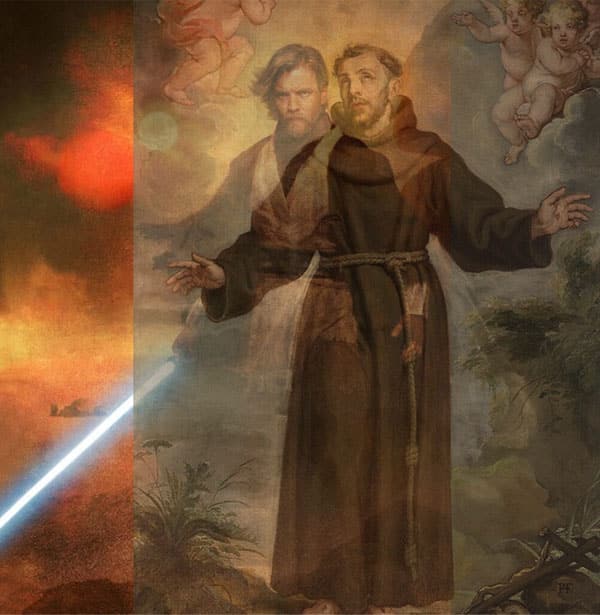
Image: William P. Hyland/Plough Magazine
Caleb Strom is a planetary scientist with a background in studying icy moons in the outer solar system. He also writes about science, faith, technology, their intersection, and how they can work together to create a better world.
More →